
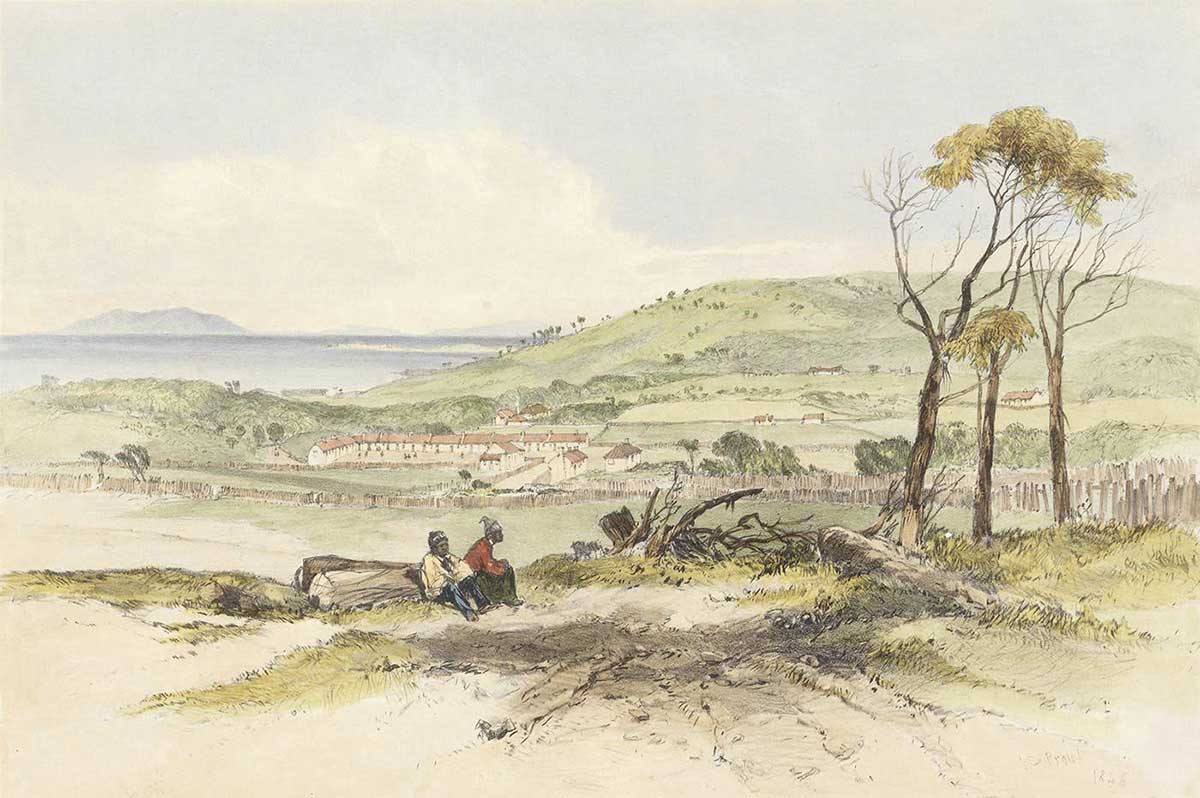
From the first recorded contact in 1772 on the island that would become known as Tasmania, relations between Europeans and the Aboriginal population were hostile.
By 1830 a virtual state of war existed and many settlers were demanding that something decisive be done.
In response, Lieutenant-Governor George Arthur ordered thousands of able-bodied settlers to form what became known as the ‘Black Line’, a human chain that crossed the settled districts of Tasmania.
The line moved south over many weeks in an attempt to intimidate, capture, displace and relocate the remaining First Nations people.
The plan failed in the short-term but it ultimately allowed Europeans to take control of the region.
Lieutenant-Governor of Tasmania, George Arthur, September 1830:
The community being called upon to act en masse on the 7th October next, for the purpose of capturing those hostile tribes of the natives which are daily committing renewed atrocities upon the settlers … Active operations will at first be chiefly directed against the tribes which occupy the country south of a line drawn from Waterloo Point east, to Lake Echo west …
First Tasmanians
Until about 12,000 years ago low sea levels meant that Tasmania was joined to the Australian mainland by a land bridge. The original Tasmanians settled the area by migrating from mainland Australia across this bridge an estimated 40,000 years ago.
When sea levels rose due to the vast melt that followed the end of the last ice age, the land bridge flooded to form Bass Strait. Tasmanians, on the island they called Lutruwita/Trouwerner, developed in isolation from other mainland Australian Aboriginal nations.
The environment was resource rich, providing excellent hunting grounds and fresh water sources for Tasmania’s First Nations people. Prior to European colonisation, there were up to 15,000 Aboriginal people living on the island.
European settlement
While Abel Tasman was the first European to map parts of the island, naming it Van Diemen’s Land in 1642, the first documented contact between First Nations people and Europeans occurred in 1772.
French sailors, led by Marc-Joseph Marion Dufresne, came ashore on the east coast of the island and encountered members of a coastal tribe. This first contact quickly became hostile, and at least one Aboriginal man was killed.
Whaling and sealing were the first European industries in Australia after British colonists and convicts began arriving from 1788. The movement of ships through the Southern Ocean led to further contact between First Nations people and Europeans, especially on small islands off the coast.
These Europeans were responsible for introducing diseases into the Aboriginal population, as well as abducting First Nations women and children to be used as ‘wives’ and labour on ships, actions that devastated coastal communities.
The first permanent European settlement on the island was at Risdon Cove in 1803. The British established the settlement not only to expand their Australian colony but because they were concerned that the French, with whom they were at war, might try to claim the island.
These British arrivals consisted mainly of military personnel and convicts, and a small number of free settlers. The initial population numbered fewer than 3,000. However, by 1830 it had increased to about 23,500. By then Europeans increasingly used the name Tasmania to describe the island, although it was not until 1856 that it would be formally renamed.
Aboriginal resistance
A rapidly growing British population and the ongoing destruction of First Nations communities by disease, dispossession and violence led to intense conflict between the two groups. Aboriginal people were vehemently opposed to British expansion and its impact on their home and communities.
By the mid-1820s the situation had become desperate for First Nations people, whose numbers had fallen to fewer than 2,000 by about 1818.
Nearly one million sheep had been moved into prime grazing land that was also the native habitat of food sources like kangaroos and other native animals. The sheep destroyed local ecosystems and disrupted food and water sources.
In about 1824 the ‘Black War’ began. The most extensive conflict in Australian history, the Black War was extremely violent. Settlers drove the island's First Nations people from their lands, murdering many. Aboriginal warriors also attacked and killed settlers and their families, raiding houses and farms for food and resources, and trying to drive out the British.
Most of the frontier conflict was concentrated on the traditional lands of four nations – the Oyster Bay, Big River, North Midlands and Ben Lomond peoples. The land in this region was extremely productive and was quickly occupied by European settlers.
Some of the most famous Aboriginal resistance leaders from these nations were Tongerlongter, Montpeliater, Mannalargenna, Umarrah and Wareternatterlargener.
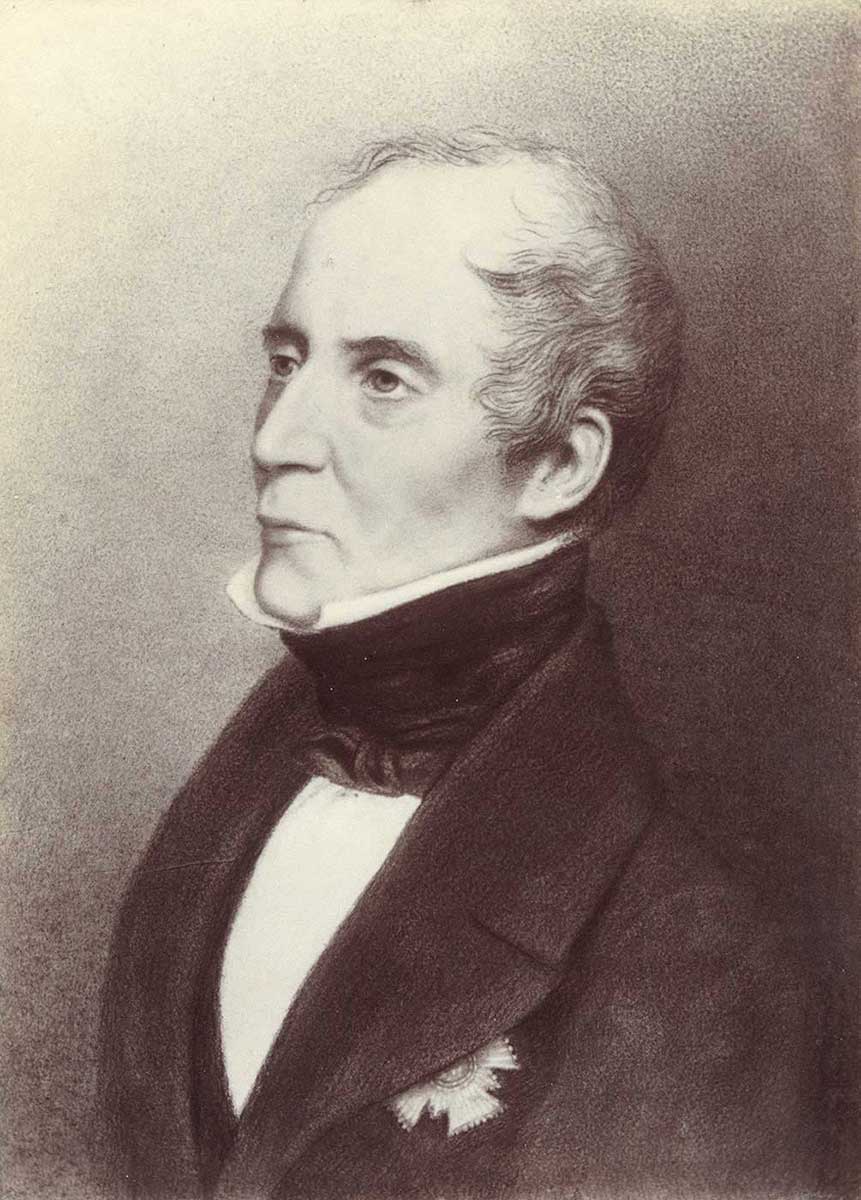
George Arthur
Colonel George Arthur took up office as Lieutenant Governor of Van Diemen’s land in 1824, just as hostilities with First Nations people began to have a significant impact on the British population of the island.
Initially, Arthur dealt with Aboriginal resistance-fighters by treating them as criminals and bringing them before the courts for punishment when they were caught.
By 1826 this approach was proving fruitless, and Arthur declared all resistance-fighters to be insurgents, meaning that soldiers and police could raid camps without provocation to arrest and detain any First Nations people they found.
Many First Nations people were shot on sight, including women and children, leading to further escalations in retaliatory violence.
In 1828 the fighting had become so vicious that Arthur declared martial law in the settled districts, labelling First Nations people as ‘open enemies’ of the state and giving them no protection under the law.
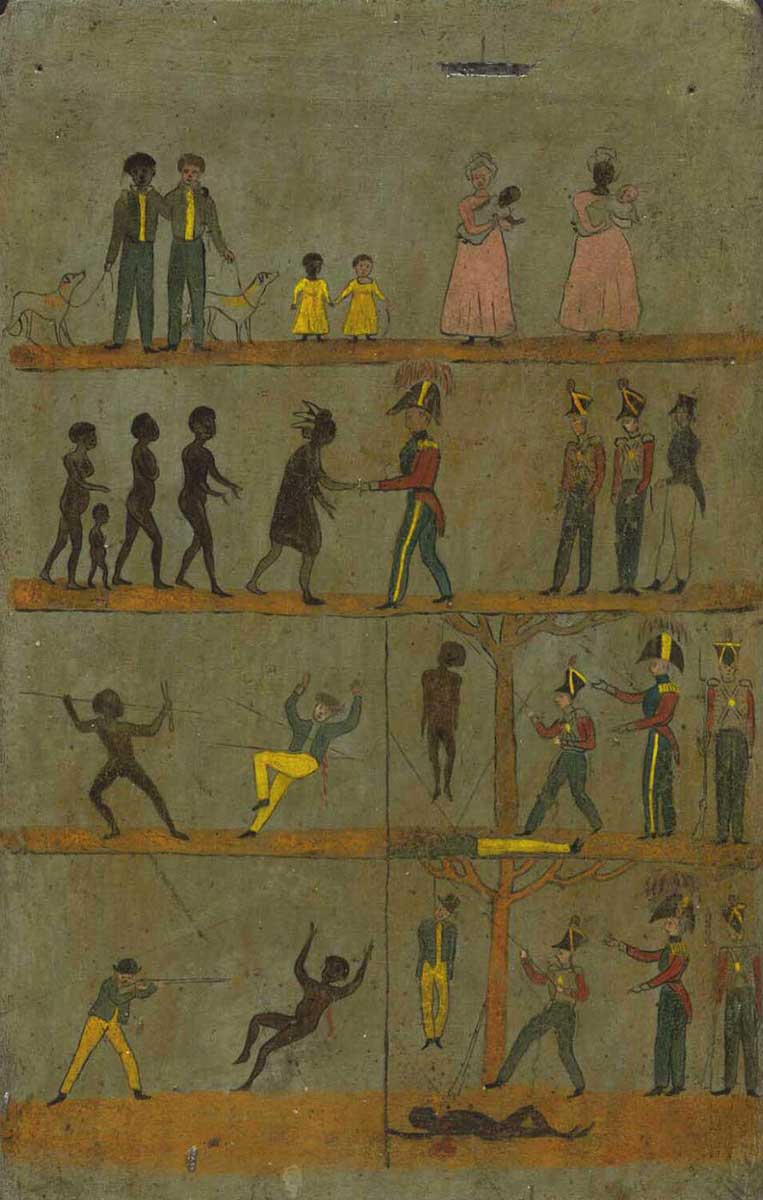
In 1830 Arthur issued his now famous proclamation (pictured below), implying equality under the law for both black and white citizens, in an attempt to calm the escalating situation. This equality was, however, non-existent, with white people seldom properly punished for the same crimes for which First Nations people were hanged.
By 1830 all attempts to quell the violence were failing. Arthur was openly criticised by settlers who felt he wasn’t doing enough to protect them and their assets, and the issue was often discussed with passion in the colony’s press.
In September 1830 under pressure from the advisory Aborigines Committee, made up of private citizens who threatened to take matters even further into their own hands, Arthur called for a leveé en masse (a large conscripted force of able-bodied men).
Black Line
The leveé, soon called the ‘Black Line’, was designed to force the Oyster Bay, Big River, North Midlands and Ben Lomond nations from their lands.
Colonists would form a line stretching across the settled districts and move south, pushing men, women and children of those nations onto the Tasman Peninsula where they could be rounded up.
From there they would be relocated to Tasmania’s offshore islands, putting an end to their resistance.
The authorities had estimated that the number of First Nations people in these settled districts might be in the low thousands, based on the damage to European settlements they had done.
The reality was that most of the population had died or moved to other districts, and it is likely that fewer than 300 remained.
The Aboriginal people who were still on their traditional lands were very organised and used guerrilla warfare tactics to inflict high levels of damage despite their low numbers.
On 7 October 1830 more than 2,200 settlers, military, police and convicts, reported to seven prearranged locations across the settled districts. The largest force ever mobilised against Aboriginal people anywhere in Australia, the line represented about ten per cent of Tasmania’s European population.
The costs associated with this operation were huge, amounting to more than £30,000, about half of the revenue collected in the colony that year.
Over a number of weeks, three separate lines of men moved slowly across the Tasmanian landscape. While there were sightings of First Nations people, the line did not have much success in forcing them to the south, with most slipping back into their traditional lands.
Only two Aboriginal people were documented as captured, and the same number recorded as killed during the operation.
Relocation and destruction
While the Black Line was considered a logistical failure, in the long term it did have the effect desired by government authorities and settlers.
The scale of the operation, along with ongoing violence and disruption from Europeans, troubled First Nations people and they began to avoid living in the settled districts. Most were eventually persuaded to surrender to the authorities.
George Augustus Robinson, an Englishman whom Governor Arthur had appointed as Superintendent of the Aboriginal Establishment at Brune Island in 1829, often negotiated this surrender.
Robinson learned some of the local languages, and attempted to form cordial relationships with people in the settled districts. He frequently travelled with Aboriginal Tasmanians, like Truganini, using them as intermediaries and representatives who could convince groups to relocate.
The small population of about 200 First Nations people who remained in the settled districts after the line were gradually removed to Wybalenna, a settlement on Flinders Island in Bass Strait run by Robinson.
Confined to poor accommodation, exiled from their homes, suffering emotional trauma, plagued by disease and severely malnourished, most of those at the settlement died within a few years.
By 1847 only 40 people still survived at Wybalenna. Considered the ‘last remaining’ members of Tasmania’s Aboriginal population, this small group was relocated to the Tasmanian mainland at Oyster Cove. By 1876 all but one of them had passed away.
Tasmanian Aboriginal population today
Despite the savage reduction in their numbers and widespread attempts by settlers to remove all First Nations people from the colony of Tasmania, the Aboriginal population in the state today is thriving. According to the 2021 census more than 30,000 people in Tasmania identified as Aboriginal and/or Torres Strait Islander.
Culture and traditions, passed down by the First Nations survivors of early European violence, are alive and well. Traditional skills such as basket and necklace making and mutton birding are prominent in the community, who also participate in ceremony and learning and sharing language with younger generations.
References
Penelope Edmonds, 'The proclamation cup', reCollections, October 2010, vol.5, no.2
putalina (Oyster Cove), Encounters exhibition, National Museum of Australia
John Connor, ‘British Frontier Warfare Logistics and the “Black Line”, Van Diemen’s Land (Tasmania), 1830’, War In History, April 2002, vol. 9, no. 2, pp 143–158.
Henry Melville, The History of Van Diemen’s Land From the Year 1824 to 1835, Inclusive, During the Administration of Lieutenant-Governor George Arthur, ed. George Mackaness, Australian Historical Monographs, vols 25–27, Sydney, 1959.
Lyndall Ryan, Tasmania Aborigines: A History Since 1803, Allen & Unwin, Crows Nest, 2012.