

Explore Antarctica
Model of the Nella Dan (replica)
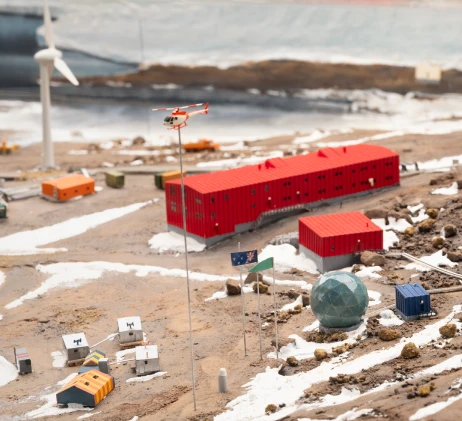
Explore this 3D model of the MV Nella Dan – Australia's lifeline to Antarctica for 26 summers. Rotate, zoom and tap each point of interest. The model ship on which this 3D version is based was made and donated by the Ship Modelling Society of Victoria.
The National Museum of Australia is custodian of one of the world’s largest Antarctic collections.
This collection, which includes an extraordinary donation of more than 1,000 objects by the Australian Antarctic Division, helps reveal our complex and enduring relationship with the frozen continent.
Follow in the wake of generations of Australians who have embarked on southerly journeys seeking knowledge, wealth, adventure and fame.
Discover the inventions and innovations that make life in Antarctica possible and marvel at Australian scientists’ groundbreaking research.
Explore the depth of our remarkable Antarctic collection and the story of its acquisition in this curatorial essay by National Museum curator Dr Jono Lineen.
BEHIND THE SCENES
Watch conservators prepare preserved sled dog and penguin specimens for display, including using X-ray fluorescence to detect heavy metals like arsenic and mercury, historically used as pesticides in taxidermy.
Send and decode messages from Antarctica, with 5-letter codes used by expeditioners in the time before email and satellites.
EXPLORE THE COLLECTION
Delve into our collection records for more on some of the most significant objects on show in Antarctica, before, during or after your visit.
This taxidermied specimen was prepared by the Australian Antarctic Division to assist in scientific research, most likely prior to the 1990s.
A taxidermied emperor penguin ('Aptenodytes forsteri') in a standing position. Its head is turned to its left. Its beak is closed and its flippers are by its sides. It is evenly coloured on the chest and front body, and the feather colour is faded overall. The back of the specimen is slightly open, showing the internal webbing. There is a metal wire protruding from each foot.
Map sampler worked in a variety of stiches with black, white, red, pink, gold, blue and tan silk threads on a cream silk ground. The maps are subtitled 'Western Hemisphere or the New World', and 'Eastern Hemisphere or the Old World'. The embroiderer, Mary Ann Wood [?] has followed the tracks of Captain Cook's first voyage (1768–1771) across both hemispheres.
In the four corners of the map are embroidered pictorial illustrations of the peoples of Europe, Asia, Africa and America. The wars, revolutions and vastly increased number of voyages of discovery that took place in the late 18th and early 19th centuries stimulated an explosion of interest in geography among the women confined, by convention, at home. In an age of increased naval, military and colonial expansion, most families would have contributed sons or brothers to Britain's various campaigns for territorial control and possessions.
The accounts of Cook's voyages were serialised for a broader readership, and women's periodicals, such as 'The Lady's Magazine', contained articles on voyages, discoveries and other current events, as well as needlework patterns. Map samplers, completed by many girls as part of their education, were also available in kit form from print sellers such as Laurie & Whittle.
A silk embroidery depicting a double hemisphere map of the world on silk fabric, backed with cotton fabric and mounted on wooden stretchers. The embroidery is titled 'A / MAP of THE / WORLD FROM / THE LATEST / DISCOVERIES', and signed 'MARY ANN WOOD'. In each corner on the map are images labelled 'ASIA', 'AMERICA', 'AFRICA' and 'EUROPE'.
Wood, Mary Ann (maker), England, United Kingdom, 1770
This sewing box is believed to have been made by Captain James Davis (1856–1933), a whaler and master mariner living in Sandy Bay, Tasmania. Captain Davis counted among his hobbies the art of marquetry – inlaying timbers to create decorative objects.
The life of a whaler was thrilling and tedious by turns. At sea for weeks on end with no sight of their prey, whalers passed the time by singing shanties, repairing gear and dabbling in hobbies like carving scrimshaw, gambling and decorative arts.
Captain Davis spent most of his life aboard ships and the box may be associated with his voyage on board SY 'Aurora' in 1912, as part of the Australasian Antarctic Expedition and as attested to in Douglas Mawson’s ‘Home of the Blizzard’ (1914). During a return trip from Hobart, Captain James Davis provided advice on whaling in the Southern Ocean.
One of Captain Davis’s 10 children was Eva Ariel Davis (1883–1942), to whom the box passed by descent, and from her to her daughter Violet Ella White (1919–2009). Most of the sewing items acquired with the box were owned and used by Violet.
A rectangular wooden sewing box accompanied by various contents. The wooden box is inlaid with flower designs accompanied by diamond and triangle patterns. There is a metal keyhole in the front and the lid is hinged. The interior of the lid features an inlaid design and a metal plate etched with 'Capt. / J.K.DAVIS, "AURORA"'. Included in the sewing box is a spindle made from bone, 316 buttons of various size, type, colour and material, nine pieces of textiles, threads, a label for thread, some elastic, six spherical blue plastic beads, and two orange plastic beads. There are also 13 silver and brass coloured metal rings, two metal safety pins, three belt buckles, two metal hooks and two loops, 15 metal pins, a metal nail, a metal screw, a metal thumbtack, a blue pencil, an orange pencil, a metal crochet hook with a protective cap on one end, a black paintbrush without bristles, a tape measure and 20 miscellaneous objects.
Davis, Captain James (maker), 1910
This pipe was found in 1959 by ANARE expedition carpenter Adrian Dean at what was known to be a former sealing or penguin oilers' camp on Macquarie Island. At some point in its history, the stem has been replaced with a hollow bird's bone, probably found locally.
Pipes of this design were originally manufactured with shorter stems, so that they could be more readily used by gripping the stem between the teeth. This reflects their association with manual workers whose employment relied on their ability to use their hands.
The date of manufacture is uncertain, but could be between the 1820s and 1910s, although the 1890s is most likely. The design depicting a bird-of-prey's claw (or possibly a dragon's claw) clutching an egg-shaped bowl was a popular format for decorative pipes between the 1880s and 1910s. It may be associated with an unknown sealer at Macquarie Island, likely during the late 19th or early 20th centuries.
Whaling and sealing were the first commercial industries in Australia. Marine mammal oil was a valuable fuel on the global market, generally used for lighting. Fur seal skin fetched a high price in Europe and Asia and during the 19th and early 20th centuries, the fertile Southern Ocean held millions of the sea mammals.
Sealing in Antarctic waters started on remote Macquarie Island not long after it was first mapped in 1810 by the British-born Australian sea captain Frederick Hasselborough. Within a decade, sealing gangs of many nationalities had decimated the island’s fur seal population and turned to harvesting the oils of the elephant seal and king penguin colonies.
As at Macquarie Island, sealing gangs at subantarctic Heard Island quickly almost wiped out the island’s elephant seal population by the mid- to late-19th century, killing the animals on the beach and flaying them for their blubber, which was then processed on site.
A pipe with a clay bowl and shank, and a hollow bird bone stem. The shank has been moulded to look like the foot of a bird with the claws cupping the bottom of the bowl. Impressed into the side of the shank is '77'. The end of the shank is inserted into one end of a cream wing bone which has dark brown marks across the surface of the same end. The two pieces are secured with a clear adhesive. The same adhesive is also present around a crack near the base of the bowl. The inside and the rim of the bowl are stained dark brown.
1870–90
Designed by Bernard Weymouth of London and built by Walter Hood & Co. of Aberdeen, Scotland, for George Thompson, owner of the Aberdeen White Star Line, the graceful clipper ship 'Thermopylae' conveyed wool and other goods between Britain and Australia during the 1880s. Featuring a long narrow hull, a sharp bow and three raking masts, clippers were fast and their fearless captains were revered for record-breaking voyages to the other end of the world.
A model of a green and orange-red ship featuring three masts and three white lifeboats. Painted in white on both sides is the word 'THERMOPYLAE'. The ship is housed in a timber case with glass sides.
1970
Tannatt William Edgeworth David was a highly regarded English-born geologist. Professor Edgeworth David wore this balaclava when he was chief scientific officer on Ernest Shackleton's 1907–09 British Antarctic Expedition on the 'Nimrod'. Accompanied by Douglas Mawson and Alistair Mackay, Edgeworth David led a gruelling four-month, 2,028-kilometre expedition to the South Magentic Pole.
A grey-brown coloured knitted balaclava. It consists of plain stitching in most areas, and ribbed stitching around the face opening and neck. There is a front and slightly larger back flap in plain stitch below the chin line.
This sled was used by meteorologist Cecil Madigan (1889–1947) on Mawson's Australasian Antarctic Expedition of 1911–1914. Madigan was a member of the main base party at Cape Denison, Commonwealth Bay.
According to AAD dog team specialist Rod Ledingham, this is a manhaul sled, used by Madigan on his traverses. However Rod noted it could have been used as a dog sled in the second year of the AAE because at this time, the design of manhaul and dog sleds was similar.
A sled with wooden supports and a canvas stretcher secured with leather fastenings and copper nails. The rounded front end is wrapped in rope with a loop of rope near the centre. A second length of rope is tied to the struts on both sides of the sled below the wrapped section. Painted in black across the front board is 'L.T. MADIGAN / ADELAIDE.'.
Antarctica
This hydrographic chart was used by Hubert Wilkins (1888–1958), the Australian war correspondent, photographer, naturalist, geographer, climatologist, aviator and polar explorer. Wilkins first visited Antarctica on JL Cope’s failed Graham Land voyage 1920–21 and then again with Sir Ernest Shackleton's 'Quest' expedition of 1921–22.
Between 1926 and 1928 he made a series of long-distance flights across the Arctic including the longest flight in a polar region, and a trans-Atlantic flight from Alaska to Spitsbergen for which he was knighted. In 1928 he undertook the first aircraft fights over Antarctica, taking off from Deception Island and exploring the peninsula.
He returned to Antarctica in 1930 and then four times over the next decade (1933–34, 1934–35, 1935–36, 1938–39) for aviation expeditions with the American millionaire and adventurer Lincoln Ellsworth.
A map of the Antarctic Region with an inset map of Peter 1st Island and including handwritten annotations concerning geographical features. Printed in the top left corner is 'ANTARCTIC REGIONS / SHEET VI / Between Latitutdes 60°.S. and 75°.S. / and Longitudes 103°.W and 40°.W. ...'. Stamped in purple above this is 'INCREASE 50 [illegible symbol]'. Deception Island is highlighted on the map with two orange dots and a pencil line indicating a bearing. Printed across the bottom is 'London. Published at the Admiralty, 7th Mar. 1901, under the Superintendence of Rear Admiral Sir W.J.L. Wharton ... Crown Copyright Reserved. ... Engraved 1901 / Processed 1924 / 3175' and 'New Editions ... 7th July 1933.' On the back of the map is a printed label and an inscription in blue ink that reads 'Sir H. Wilkins / Chart'.
London, England, 1933
Proclamation of British sovereignty over King George V Land (Antarctica), which was written by physicist and surveyor Alexander Kennedy and signed by Douglas Mawson on 5 January 1931. Mawson read this proclamation to a small group of his fellow explorers at Cape Denison, before the document was buried in a handmade canister in a cairn at Commonwealth Bay, Antarctica.
The canister was made from empty food tins welded together. Another proclaimation was made by Mawson at Mac.Robertson Land on 18 February 1931. During the 1976–77 summer expedition of the Australian Antartic Division (AAD), the proclamation was removed from the cairn at Cape Denison and returned to Australia aboard the MV ‘Thala Dan’. It was deposited with the National Library of Australia and later transferred to the National Museum of Australia.
Mawson led three research expeditions to Antarctica, the first from 1911–14, and the second and third – British, Australian and New Zealand Antarctic Research Expeditions (BANZARE) – in 1929–30 and 1930–31. However, as well as the advancement of scientific exploration, oceanographic work and biological knowledge, great emphasis for Mawson's later voyages lay on British intentions to pre-empt territorial expansion by Norway, which was intent on securing rights over Antarctic territory to support and extend its whaling industry.
Instructions issued by Prime Minister Stanley Bruce to Mawson on 12 September 1929, explained clearly that territorial acquisition (in Bruce's words, to 'plant the British flag') was to be a chief objective of his voyages. The document is important in terms of territorial claims and international politics. Mawson's team were the first to map much of the coast, and this provided firm foundation for sovereignty over 5,800,000 square kilometres, or 42 per cent, of eastern Antarctic Territory to be transferred from Britain to Australia under the 'Australian Antarctic Territory Acceptance Act 1933', which came into effect in 1936.
A proclamation written on rag paper in copperplate by AL Kennedy, a physicist in Mawson's party, and signed by Sir Douglas Mawson, dated '5-1-31'. It declares that 'the full sovereignty / of the Territory of King George V Land / and its extension ... / vests in His Majesty / King George the Fifth, his heirs and / successors, / forever'.
Mawson, Sir Douglas (author), Kennedy, Alexander Lorimer (scribe), Cape Denison, George V Land, Antarctica, 1931
Used by Frank Hurley during the the British, Australian and New Zealand Antarctic Research Expedition (BANZARE) in 1929–31. Hurley did more than any other Australian to embed Antarctica in the national psyche. His films 'Home of the Blizzard', about the 1911–14 AAE expedition, and 'Siege of the South', filmed on the 1929–31 BANZARE expeditions, were shown across the country. They introduced Australians to Antarctica's beauty and extremes – the howling winds, towering icebergs, relentless blizzards and cramped living quarters.
A Debrie Parvo model 'L' 35mm hand-crank movie camera and accessories, consisting of a camera shutter, five lenses (one with a bellows attachment), a view finder, an extension tube and a camera case.
Andre Debrie (maker), Paris, France, 1917
The Robert and Irene Goard collection comprises cameras and other photographic equipment owned and used by prominent Australian photographers and businessmen Charles Kerry, George Rose and Frank Hurley and amateur photographer and engineer Ernest Macartney de Burgh.
The collection includes a dry whole plate field camera and a wet plate sliding box camera used by Kerry, a Lizars Challenge stereo camera owned by George Rose and a 35mm Debrie Parvo cine-camera acquired by Frank Hurley for the 1929–30 British, Australian and New Zealand Antarctic Research Expeditions. It also includes a Sanderson folding plate camera awarded to de Burgh by the Institute of Engineers to recognise his securing the prestigious Telford Premium award in 1903–04.
From the 1880s to the 1920s, professional Australian photographers such as Kerry, Rose and Hurley created an extensive record of urban and rural life in eastern Australia and developed highly successful businesses producing and selling portraits, landscape views and news and event photographs as prints, postcards and stereocards.
These photographers also exhibited overseas and imported views of the world, including, for Hurley, of Antarctica, for Australian consumption. Through these practices, photographers such as Kerry, Rose and Hurley shaped both Australians' understanding of and interest in their own social and natural environments and Australians' perception of their place in the world.
This flag is associated with the HMALST 3501, a ship built in Canada in 1943 for the British Royal Navy and acquired for the Royal Australian Navy after the war. ANARE established a base at subantarctic Heard Island in 1947. During early expeditions, ANARE struggled to charter a suitable ship to resupply stations.
Although not particularly suited to subantarctic conditions, the HMALST 3501’s first voyage with ANARE was to Heard Island in 1947. This flag is associated with this first voyage, and was donated to the Australian Antarctic Division by Alan 'Froggy' Balmer in 1998. Mr Balmer may have been RAN staff or crew.
Despite challenging conditions and limits to its abilities, the ship (later known as HMAS 'Labuan') completed seven voyages with ANARE from 1947 to 1951. Until the station at Atlas Cove closed in 1955, 91 expeditioners mapped the region's topography and studied the island's animals, plants, rocks, weather and atmosphere.
A pennant flag with white text and a white border on a black felt background. On the left side is a coat of arms featuring a crown on top of a braided ring encircling a ship in front of an iceberg. There is a penguin and seal on either side of the ring and text in a banner underneath that reads 'R.A.N.'. On the right it reads 'H.M.A.L.S.T 3501 / AUSTRALIAN NATIONAL / ANTARCTIC RESEARCH / EXPEDITION / 1947–48'. There is a white felt border at the wider end.
Administered by the newly formed Australian National Antarctic Research Expedition (ANARE), the expedition program included the 1948 establishment of a small station on Macquarie Island. This ice hoe was used by Norman Laird, the expedition's photographer, during this first winter season spent on the island.
A combination metal hoe and pick with a wooden handle. The hoe blade has a sharpened v-shaped edge, while the pick is slightly curved with a straight edge. The handle is attached to the tool head via a metal collar and white packing tape. At the opposite end of the handle is a metal fitting with a cylindrical protusion. Handwritten in black on both sides of the handle is 'NORMAN LAIRD'.
This ration pack is an example of standard-issue field rations developed by ANARE in 1985. For short trips into the field, ANARE expeditioners usually take fresh food from the station. However, food ration packs are provided for emergency use and on field trips of longer duration. Known as ‘rat packs', food ration packs are lightweight, nutritious, interesting and easy to prepare. They are packed in plastic ‘nally’ bins and are marked as 12 or 15 day packs for one person. They may be supplemented by additional goodies from a ‘supplementary’ ration pack. They are sealed with plastic bands when new and marked by date. 'Rat packs’ include such items as freeze dried meat and vegetables, rice, pasta, biscuits, dried fruit, soups, muesli bars, desserts, chocolate, tea and coffee. Emergency rations must always be carried to preserve life, even on very short trips.
A wooden crate with a hinged lid containing various rations. The edges of the lid are reinforced with metal and the lid can be secured closed via two lengths of cotton tape. Stencilled in black on the crate is '12. DAY RATION / 1985' and 'A.N.A.R.E. / 1985'. There is also handwriting in black that reads '12 DAY / RATION'. The rations include a salt shaker, a pepper shaker, four satchets of Continental freeze dried soup, 10 packets of Swallow's biscuits, six packets of Alliance freeze dried meals, two packets of Alliance freeze dried rice, two packets of dried onions, five packets of Continental dried vegetables, a jar of Vegemite, a container of Keen's curry powder, a tin of instant coffee, a tin of Nestlé milk powder, a tin of dried egg powder, two tins of Allowrie butter, three blocks of Cadbury chocolate, a bag of dried fruit, a bag of cereal, a bag of muesli, a bottle of Bushells tea powder, a jar of smooth peanut butter, a jar of 12 black pills, a container of creamed honey, a bag of CSR sugar, 15 packets of Kraft strawberry jam, a plastic shaker bottle, a metal can opener, and five packs of Deb instant mashed potato.
1985 (date of issue)
Brought out for special film nights that often coincided with the issuing of the cigar ration. Coinciding with the issuing of cigar rations, regular film and slide shows provided a raucous evening’s entertainment. The most popular films deeply influenced the culture of everyday life on station.
A green and black metal slide projector with a grey cord accompanied by a black rubber lens cap, two slide holders, three light bulbs and a case. The projector comprises two sections which are mounted on a rectangular base. The front section has a grill with a round red and silver 'W' logo, a lens engraved with 'WATERWORTH - HOBART', and a grey dial with a red, blue and silver sticker that reads 'AUSTRALIAN / MADE'. The back section houses the light that shines through a round pane of glass with grooves above and below. The same 'W' logo appears on both sides of this section and on the top is a black grill. On the base of the projector are two dials, a switch, and a grey electrical cable which is damaged near the plug. The bottom of the base has four feet and a silver and red plaque reading 'MODEL C No 8347 / 240-250V A.C. ONLY / MADE BY E.N. WATERWORTH / HOBART TASMANIA'. The case for the projector has a hinged lid, two metal latches and a grey handle. The corners of the case are reinforced with black metal pieces. Handwritten in black on the top of the lid is 'FOR USE IN CASE OF / CIGAR ISSUE.' The interior of the case is covered with patterned paper in brown tones, and mounted into the lid and base are card and metal supports. Handwritten in red and black on the lid's interior is 'Ser No 8349 / A.N.A.R.E.'.
E N Waterworth (maker), Hobart, Tasmania, Australia
This fire alarm was used in an Antarctic research station and represents the importance of fire suppression systems in Antarctica. Antarctic stations store thousands of litres of flammable fuel and their industrial kitchens operate for 18 hours a day, so fire is a huge risk. And with temperatures as low as -50˚C, putting out any fires is incredibly difficult. All personnel in Antarctica are trained to respond as soon as a fire breaks out.
A wall-mounted fire alarm consisting of a red painted metal box with a hinged front. Cream painted, embossed text on the front reads 'FIRE ALARM / BREAK GLASS / PRESS BUTTON'. Inside the box is a cream metal plate with a red button in the centre. There are holes in both the top and the bottom of the box.
A small personal first aid kit issued to ANARE expeditioners in Antarctica in the 1950s and 1960s. Even minor injuries can become fatal out in the field, far from medical assistance. During the 1960s, expeditioners carried personal first aid kits containing a cocktail of pharmaceuticals in defence of any misfortune. This type was designed to fit in the pocket of a standard-issue ventile jacket.
An Australian National Antarctic Research Expedition first aid kit. The kit is housed in a red and pink rectangular cardboard box with a slide-out tray, and its contents are described on a printed label on the lid. Some of the described contents are missing from the kit. Included are four plastic sachets of tablets: Ronicol for frostbite, Gelusi for indigestion, Saridone for headaches, and salt for cramps. Also included are a tube of eye ointment for snow blindness, an ampule of Tubinic Omnopon Grs for severe pain, three Elastoplast strips and one adhesive patch. Along the top of the label is faded handwritten text in black ink that reads 'SAMPLE ONE [...?] MEDICATION'. Handwritten in pencil on the bottom is 'MB Pittman / MB 4411'.
A cotton Ventile jacket owned and worn by Diana Patterson who, in 1988, was the first Australian woman appointed Officer in Charge of an Australian Antarctic station. At the time, clothing and supplies specifically for women were not standard issue so Diana selected this man’s jacket in the smallest size available.
A yellow cotton Ventile jacket with a wired hood that has black fur, a zipper and drawstrings. It has a zip-up pocket with a velcro closure at the centre of the chest, zip-up access points on the left and right side, and smaller zip-up pockets with flaps and velcro closures on the lower left and right side. The interior of the jacket is lined with green cotton fabric. Sewn to the back of the neck is a cloth label with black text reading 'KINDRED MANUFACTURING / PTY. LTD. / SIZE SM / MADE IN AUSTRALIA / NAME'.
Australian Antarctic Division (issuer), 1988
Sled dogs became a part of Australia's Antarctic expeditions in 1949. The stock came from dogs left in Australia by a French expedition – Phillip Law, Director of Australian National Antarctic Research Expeditions (ANARE) had the dogs cared for at Melbourne Zoo and arranged to keep the pups born there.
Dogs were first used at training camps at Heard Island before establishing a long-term breeding program at Mawson station in 1954. Their descendants – over 260 dogs – lived and worked at Mawson until 1992. Dogs were also used also at Davis and Wilkes research stations.
ANARE used sled dogs for exploration over sea ice and inland plateau. They were reliable over sastrugi and crevassed terrain, economical and much loved. In 1991, sled were removed from the Antarctic to comply with the 1991 Protocol on Environmental Protection to the Antarctic Treaty, known as the Madrid Protocol. By then the dogs were less useful compared to other advanced transport, but their companionship was irreplaceable.
This taxidermied sled dog dog is Shep, born at Mawson station in 1980. Shep was named for one of the expeditioners, Radio Technical Officer Kev Shepherd. Station logs record that Shep was 'a good worker ... highly strung though and tends to panic in certain situations (ie, weigh-in or being loaded onto traverse sledges), likes attention, but needs to work on sit and wow commands'. He died in 1983 during a blizzard that struck a sea ice traverse party from Mawson, and his body was returned to Australia.
The expeditioners recalled Shep as a 'good solid worker with good spirit and a great loss'. He was taxidermied and displayed at the Australian Antarctic Division in Hobart, where Mr Shepherd later came across him. 'My heart stopped and I just stood and stared, remembering happier times with my old friend. At first I wondered how they could do this to him, but seeing him in fine shape, I realised that it would give many people an appreciation of the working dogs of Mawson, and who better to represent them than Shep', he recalled.
A taxidermied husky dog 'SHEP' with a stamped aluminium name tag fastened to his leather collar. The dog is standing, his mouth is open and he is looking a little to his right. He has light coloured fur with darker areas around his head, shoulders and tail. The taxidermied specimen is mounted on a fibreglass frame.
Mawson station, Mac.Roberston Land, Antarctica
This collection was assembled by ANARE expeditioner Adrian Dean while stationed for 13 months as carpenter at Macquarie Island in 1958–59. The box is handmade and contains letters to and from Mr Dean and his family and friends. Opportunities to exchange correspondence were limited to the visits of resupply vessels to the island, but Adrian and his wife, Peggy, still wrote hundreds of letters to each other. They also prepared cards in advance of special occasions such as birthdays.
A wooden box containing multiple personal letters, a toy figure and a handkerchief. Most of the letters are between Adrian Dean and his wife, children and parents and are handwritten in addressed envelopes with some containing greeting cards, drawings and publication clippings. Also included are newsletters, telegrams, a leaflet for the 'Princess of Tasmania' ship and two letters from the director of the Antarctic Division of the Department of External Affairs and. The toy figure is made from pipe cleaners and paper, and the handkerchief features a geometric design with the impression of pink lipstick in the centre. The wooden box is painted black and features handwritten text in graphite that reads 'I LOVE YOU / DARLING / XX0XX'.
Dean, Adrian Barclay (writer), Dean, Claudia Margaret (Peggy) (recipient), 1958
Satellite communication revolutionised Antarctic communications. ANARESAT (ANARE Satellite) was operational from 1987. This made phone-to-phone communication with Australia possible for expeditioners and enabled data transfer. Similar test telephones were supplied to all ANARE Antarctic and Macquarie Island stations to test the ANARESAT system.
This phone tested equipment at Macquarie Island station. To talk to other Antarctic stations from Macquarie Island, calls were directed through the Oxford Falls Earth Station, Sydney. These phones were used until the system went digital in 1996.
A brown coloured telephone with a coiled cable joining the base and the headset. The base of the telephone features a number pad, five switches, six outlets on one side, and three stickers including a green and black phone number, a red and black phone number, and a black and white sticker that reads 'DECADIC DIAL / VF DIAL / TIMED LOOP / BREAK'. Attached to the back are two cables, one of which runs into a 'SATELLITE EQ / ADAPTER' and splits into three cables. The cables are held together with a coil of plastic. Adhered to the bottom of the telephone are three stickers, including a wiring diagram a 'MODIFIED TO' sticker and a 'Telecom Workshops' sticker.
1984
This barge caravan was one of the first structures used in Antarctica when Mawson station was established. Four barge caravans were built for ANARE in Melbourne in 1953–54. Designed by Benson and Shaw in collaboration with Bob Dovers, Officer in Charge (OIC) at Mawson station in 1954, they were intended to be towed behind Weasel oversnow vehicles.
The two halves of the caravan could be unbolted and the inverted top stored inside the base to save space when being transported to Antarctica. This example is one of two improved barge caravans that were built in 1954 and sent to Mawson in 1955 for use by John Béchervaise (1955 OIC) and the 1955 Mawson expeditioners.
One was left near Depot Peak and has since been lost. This caravan remained at Mawson until taken to (and left at) Binder's Base, near Mount Creswell in the southern Prince Charles Mountains in 1959 by Syd Kirkby (surveyor), Neville Collins and 2 others.
It was rediscovered by Dave McCormack in the 2002–03 PCMEGA traverse and returned to Australia. John Berchevaise later designed a new, PID plywood caravan to replace the barge caravans, which were too big and difficult to access. The only existing PID caravan is still at Mawson. Eventually the plywood caravans were replaced with fibreglass RMIT caravans.
A barge caravan accompanied by a metal cable, a sleeping bag, two stoves, a kerosene bottle, a Penfolds port bottle, a note pad, match boxes, a toaster, a pressure cooker, a lamp, light bulbs, two fire extinguishers and a kerosene heater. The barge caravan consists of trapezoid-shaped top and bottom sections bolted together with ferrous nails and bolts. The top is painted yellow and the bottom orange and silver. The bottom is constructed from plywood and has a slightly curved base and sides with four metal-capped hardwood runners running from front to back with three uncapped runners between. Along each side of this section are two rubbing strips. There are two 'D' shackles attached to each corner at the front and two metal eye bolts attached to each corner at the back. At the join between the top and bottom sections, there are two metal eye bolts attached to each side and metal jacking points at each corner just below the join. The top is constructed from plywood and has straight sides and roof. There are non opening rectangular perspex windows with rubber gaskets on each side, at the front and at the back. Extending from the exterior of the right side is an electric cable and an electric plug. There are two insulated fittings attached near the front of the right side and a wire aerial attached to the right of the front window. On the roof are two access hatches with hinged plywood covers, and metal brackets. There is also a metal chimney and a metal flag pole fitting attached to roof. The uninsulated interior is painted light grey blue and has pine, light green sleeping platforms along both sides. There are double metal hooks attached at each corner, and an electric plug and light. The interior is internally strengthened with horizontal battens and has a timber floor in the centre.
Dovers, Robert George (designer), Melbourne, Victoria, Australia, 1954
This theodolite would have been used in Antarcitca for surveying from the 1960s to the 1980s. This theodolite, a DKM2 was manufactured by Kern Aarau in Switzerland from 1966. A theodolite is an instrument used for measuring angles both horizontally and vertically and was essential for accurate surveying.
A green metal theodolite with black and silver fittings. The theodolite has a flat, round base plate (tribach) with levelling screw adjustments and a round, flat rotating main stage which is the telescope mount. There is a horizontal spirit level mounted on the stage. The telescope is mounted between two vertical arms, the bases of which are screwed to the main stage. There is an enclosed vertical degree scale on the side and a spirit level mounted on top. Below the spirit level there is a hinged silver metal flap with a mirror inside. Impressed and painted cream on the arm of the theodolite is the text 'Kern / AARAU / SUISSE / SWITZERLAND / No5[?]897 / DKM2'.
1966
This Mole Mink was used in Antarctica in the 1970s by ANARE. Manufactured by Mole Engineering, Frenchs Forest, NSW, this oversnow vehicle replaced snow tractors. The Antarctic Division bought two: one in 1973 which went to Casey station and was eventually returned to Australia and sold, and this vehicle which went to Mawson station in 1975.
It was bought for $11,409.33 as a standard chassis (no cab) with engine, transmission, rear pintle, tow hook, front jockey wheels, steering gear, 26-inch tracks, adjustable upholstered driver's seat, controls and instruments with chassis and frame in undercoat paint with two parts and instrument manuals.
Items bought for the Antarctic climate included special engine wiring and installation for low temperature operation, master battery switch, 70-gallon fuel tank, snow penetration protection, steel teeth on grousers and radio suppression of engine.
The cab was made at Mawson station from odd bits and pieces and the seven back passenger seats were recovered from the Swiss Pilatus Porter aircraft which was used at Mawson before being damaged in a blizzard at Gwaam in early 1975.
A red Australian Mole Mink oversnow vehicle with metal tracks reinforced via rubber belting, the letters 'M / M' on the front grill and eight cushions covered in red fabric. There are two windows on the front, sash windows on the driver and front passenger sides, sliding windows on the sides of the back, and a fixed window in the rear door. The cab is made from sheet steel and the interior walls and floor are lined with plywood. On the roof is a hatch and metal brackets. Mounted to the side of the vehicle on the proper right side is a green jerry can with 'ATK' stencilled on the side in black. On either side of the back door are leather straps. Painted around the exterior are images and words including 'fiona', 'A.N.A.R.E.', 'Shane', 'Jane', the Australian flag, and a bird carrying multiple tools and a box labelled 'RESCUE / MINK / SERVIS [sic]'. The bird is flying towards a vehicle with its front end stuck in a crevasse while towing a sledge labelled 'ANARE'. Inside the vehicle are seats and steering levers.
Mole Engineering Pty Ltd (manufacturer), Frenchs Forest, Sydney, New South Wales, Australia, 1975
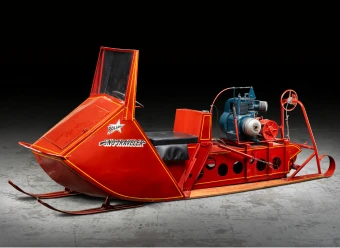
This Polaris Sno-Traveler K95 was the first snowmobile used by ANARE. It came with a standard winch system to lift the track if stuck in heavy snow and a carburetor heater (air passed over the outside of the muffler).
An oversnow Polaris Sno-Traveler, model K95 painted red with yellow pin stripes. The vehicle has metal sledge tracks at the front and a caterpillar track and wooden skis at the back. There is a latched door in front of the windscreen. The open driver’s cab has a half steering wheel, brake and throttle levers and an ignition switch on the right of the dashboard. The driver's seat is upholstered in black leather and the seat back is the fuel container. The engine is mounted behind the fuel container and a winch is mounted on the rear of the wooden skis. Logo with text painted in white and black on front left and right hand side reads ‘POLARIS / SNO-TRAVELER’. Text on badge logo in centre of steering wheel reads ‘POLARIS’. Printed white text on dashboard reads ‘U.S. Patent No. 2,970,662 / Canadian Patent No. 639,475 / U.S. Canadian and Other / Patents Pending’. Text on side of engine reads ‘KOHLER / U.S.A.’.
1964
This model is of MV 'Nella Dan', the longest serving of the Dan icebreakers chartered by ANARE from the J Lauritzen Line, Denmark. It supplied Australia's Antarctic and subantarctic stations from 1962–1987. During a wild storm in December 1987 it waas badly damaged on a reef off Macquarie Island and was later scuttled nearby.
The model was made by the Ship Modelling Society of Victoria after a proposal by Norm Neale to construct ‘a sailing model of a ship as a joint project for members’. The build started in 1971 and took over 3,000 hours. The modellers included Les Gooch, Norm Neale, Phil Molyneux, Tom Hadley, Kevin Lang, Bill Middleditch, Don McGraw, Denis Kendall and Sid Rose.
The model was constructed to 1/25 scale and is made of Western red cedar, with the hull laminated with fibreglass. The model is powered by a 6V aircraft starter motor and the rudder is controlled by a model aircraft remote control unit. The model was launched at Albert Park Lake in Melbourne on 2 December 1973.
A model of a red and white ship with black trim and brown hull on a wooden stand. There is white text that reads 'NELLA DAN' painted on the stern and proper left side of the bow. The ship includes two masts with rigging, three row boats, one tug boat, brass portholes, propeller, rudder, LED lights, and an electric cable attached to one side of the hull. The model is accompanied by a red and white helicopter with black lettering below its rotor that reads 'VH-BAD'.
Ship Modelling Society of Victoria (maker), Port Melbourne, Melbourne, Victoria, Australia, 1971
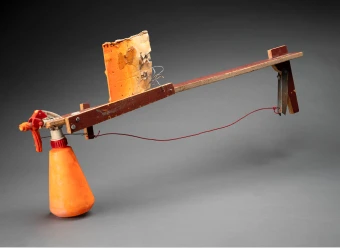
This snow gauge was developed at Mawson Station in 1957 by Dr Malcolm Mellor to measure the quantity of snow carried in snow-bearing winds at various heights above ground. The data generated by the gauges was brought back to Melbourne and analysed by Dr Uwe Radok, Meteorology Dept., University of Melbourne, where he developed a theory of drift snow transport. Mellor was an eminent glaciologist who worked with the Australian and US Antarctic operations. Radok became Reader-in-Charge, Dept of Meteorology at University of Melbourne. He was one of the Dunera Boys, a group of mainly German/Austrian Jewish men who were classifed as enemy aliens by the British government and transported to Australia in 1940. Many of them were artists, philosophers and scientists some of whom stayed in Australia after the Second World War and made significant contributions to Australian society.
A wooden box housing two snow gauges. The wooden box consists of a hinged lid with two over centre latches. The interior consists of timber framing with green padded lining in the base and underside of the lid. There is also a small compartment to one side of the box. Each snow gauge comprises several sections including a central copper cylinder and two long conical ends. On one end are two metal fins and on the other is a thin metal pipe, one from which a tiny metal pipe has been welded. There is also a thin metal pipe running through the central cylinder near its edge. The gauges are painted cream and feature either a '13' or '3' stencilled in black on their sides.
Mellor, Dr Malcolm (designer), Mawson station, Mac.Roberston Land, Antarctica, 1957
This All Sky camera was used for automatically recording auroras in Antarctica by the AAD at their Automatic Geophysical Observatories. This type of camera was developed in the 1970s and used until 1995, when it was replaced by video imagers. The All Sky camera photographed the entire sky continuously over a one minute period. It used a 400-foot (122-metre) roll of 35mm black-and-white film which lasted approximately two weeks and was then developed in the station dark rooms.
An All Sky camera with a black cast metal housing and stand. Both sides of the main metal housing have also been cut away to reveal the interior. The camera comprises a black metal main cylinder with a basal flange for attachment, which houses the film, film drive gear and electrical components. Mounted above this is the lens housing. The lens is positioned at the top and faces outwards, and the lens or lens glass is hemispherical. Currently mounted beside the lens is a round sensor with glass covered, gridded metal sheet on the top. The main housing is divided in half by a vertical metal plate. Housed on one side is the film canister/cassette, which is a black metal cylinder with a snout which has a slot in the top. The cassette sits vertically at the bottom of the housing with several film winding and feed/guiding spools above. On the other side is an arrangement consisting of a horizontal plastic spindle, and two metal sprockets on horizontal pins with a drive chain between them. At the base of the housing is a row of 3 sets of 9 metal terminals with various coloured electrical wires running from these to various parts of the camera. In front of these terminals are three pieces of tape with handwritten text. The camera housing is mounted to a cylindrical metal stand with a round foot.
This equipment was built in about 1950 to measure the frequency and intensity of cosmic particles bombarding Earth. The equipment was most likely built by a team from the University of Tasmania Physics Department led by Dr Geoff Fenton. The existing information does not indicate where in Antarctica this equipment was located.
In the 1950s a number of cosmic ray observatories were set up in the Australian region, creating a string of cosmic ray observatories that extended from Papua New Guinea to Antarctica, with each observatory being an integral element of the whole. Cosmic rays are interesting to scientists because of what they can tell us about space – where they came from and what they encountered along the way – as well as the makeup of the galaxy and the universe.
The 1957–58 International Geophysical Year was a multinational scientific project that involved researchers from 67 countries and projects that investigated auroras, cosmic rays, geomagnetism, gravity, ionospheric physics, precision mapping, meteorology, oceanography, seismology and solar activity. Antarctica was one of the key areas of investigation.Seven pieces of equipment for a cosmic ray. The pieces include two metal strips with valves/cathode ray tubes and five console units each with a different front panel. There is one console with four counters, one with an array of lights, one with various switches, one with four lights and an outlet labelled 'FUSE', and one for measuring volts.
University of Tasmania, Hobart, Tasmania, Australia, 1950
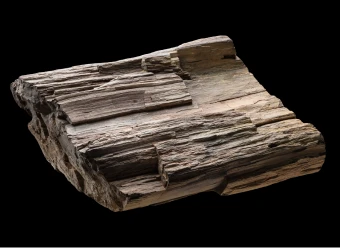
This ancient geological specimen is a piece of fossilised 'Glossopteris' tree trunk dating to the time when Antarctica and Australia were part of the supercontinent Gondwana. Found in sedimentary rocks of Permian age (between 251 and 298 million years ago), it is tangible evidence of a time when Antarctica was much warmer and had a diverse flora assemblage. During this time period, the 'Glossopteris' flora spread across the continent of Gondwana. This fossil was found by expeditioner Dr Patrick Quilty in the Prince Charles Mountains.
A cream, brown and grey piece of fossilised wood, possibly from a tree trunk. The trunk is semi-circular with an indent running down the centre. There are cracks in the stone along the rings of the tree, and traces of blue paint across the top.