
Antarctica board game object inquiry
This ‘Antarctica or the Race to the South Pole’ game was made in Australia in the early 1900s, in an era known as the heroic age of Antarctic exploration.
Use these questions below to investigate what this object reveals about the way people in the past thought about Antarctica – and consider how this compares with our understanding today.
Design your own board game and enter our competition!
Challenge your students to design a board game about Antarctica then submit a picture and enter the draw to win a very COOL prize for you or your school library!
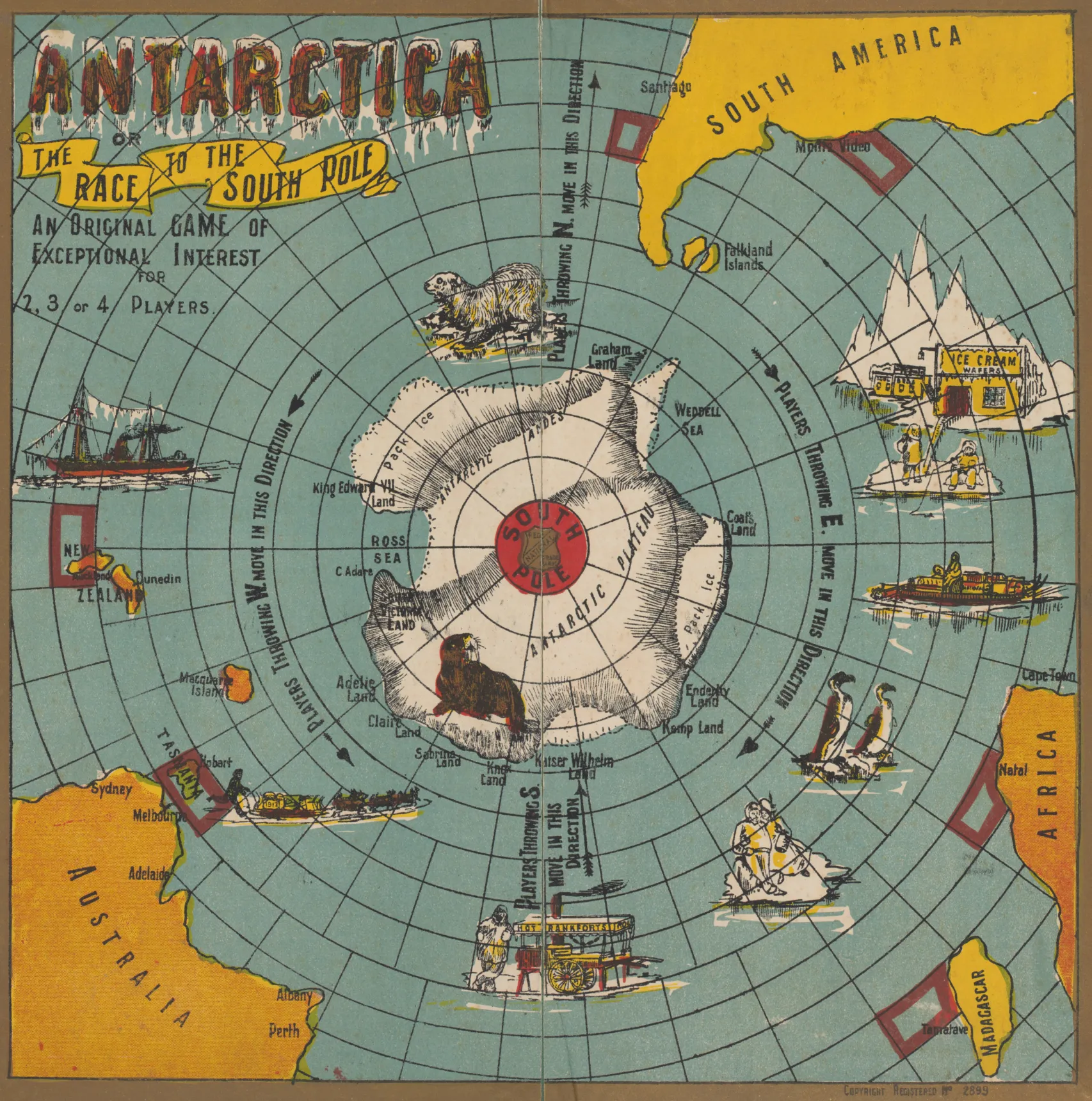
The heroic age was a time when Antarctica was seen as one of the last great challenges for exploration and people were fascinated by the idea of reaching the South Pole first and discovering the continent.
Look closely at the board game:
- What do you notice?
- Why is the South Pole at the centre and why is the game designed as a race?
- How do you think this game works?
- What does the game reveal about how people in 1913 viewed Antarctica and exploration?
- Why might countries have wanted to reach Antarctica first? What does this suggest about people’s attitudes in this era
- Does the game present Antarctica as a place of science, adventure or competition? Why do you think that?
Today, Antarctica is governed through the Antarctic Treaty System, which protects it for shared scientific research. Instead of competing to control Antarctica, countries now cooperate to:
- conduct scientific research
- protect wildlife and ecosystems
- study climate change
Look again at the board game.
- What values or ideas does the game reflect? How do we value Antarctica differently today?
- What would you change or add to make this game better reflect our understanding of Antarctica today?
Museums collect objects that reveal what was important to people in the past, or that help us to better understand history.
- Why would a museum collect a board game like this?
- How does it help us understand changing ideas about Antarctica over time?
- Every historical object tells some stories but not others. Whose stories are missing from this game, and why does that matter?
What would a board game about Antarctica look like if it were designed today?
Design your own Antarctica board game. Think about how players will move around the board. Consider what your new game will say about how the world views and values Antarctica today.
What is the purpose of your game – is it a race or a challenge? Cooperative or competitive? Are skills or luck involved? Why have you made those decisions?
Email a picture of your board game and your details to education@nma.gov.au and enter the draw to win a very COOL prize for you or your school library!
See competition terms and conditions
Banner image: 'Antarctica' board game (detail), 1913, published by National Games, Ballarat, Victoria. National Museum of Australia